Journal articles
Our peer-reviewed articles present our analysis of the project’s emerging dataset alongside key scholarly and grey literature.
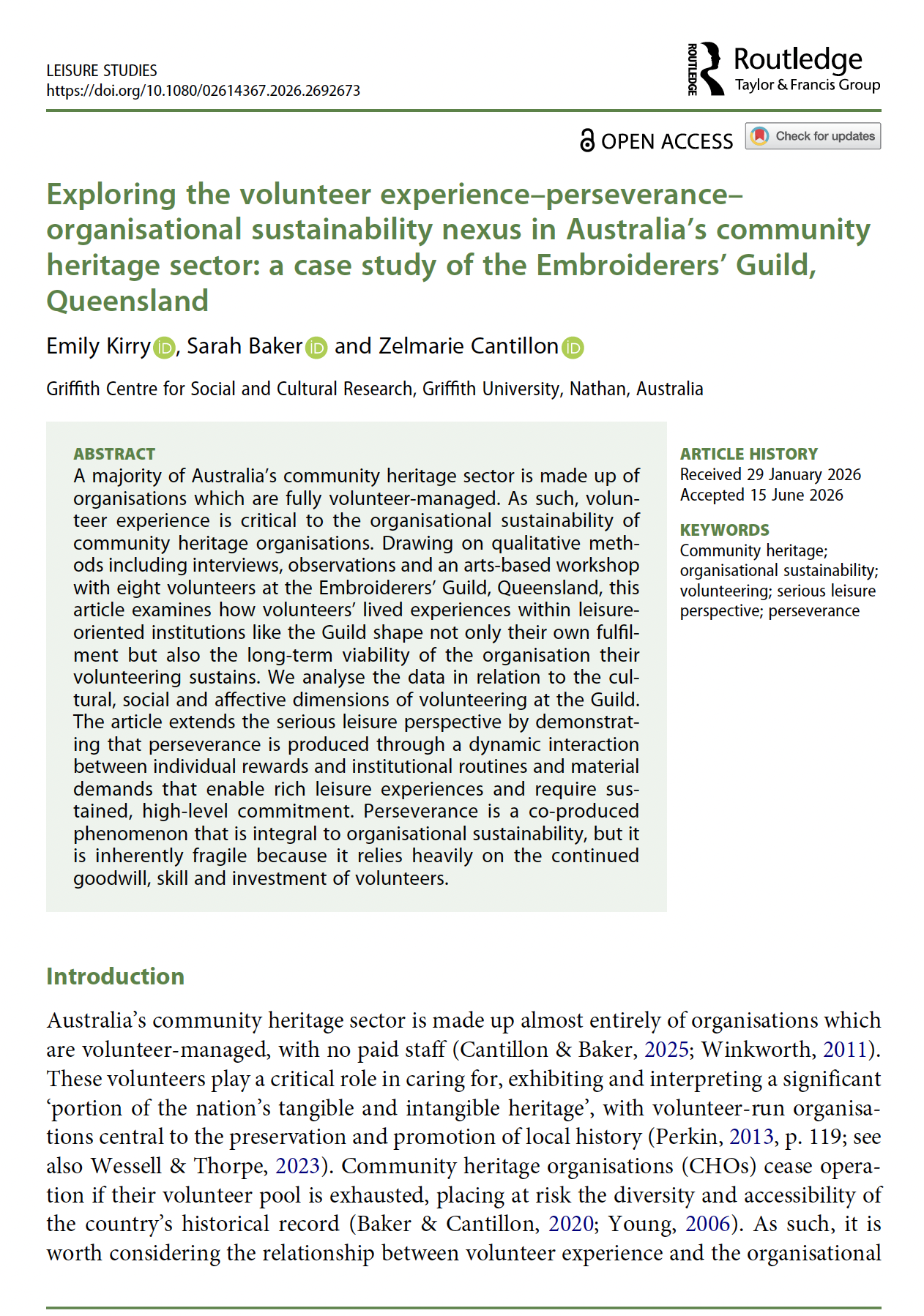
Exploring the volunteer experience–perseverance–organisational sustainability nexus in Australia’s community heritage sector: a case study of the Embroiderers’ Guild, Queensland
Emily Kirry, Sarah Baker & Zelmarie Cantillon
Volunteer experience is critical to the organisational sustainability of community heritage organisations. Drawing on interviews, observations and an arts-based workshop with eight volunteers at the Embroiderers’ Guild, Queensland, this article examines how volunteers’ lived experiences within leisure-oriented institutions like the Guild shape not only their own fulfilment but also the long-term viability of the organisation their volunteering sustains.
We analyse the data in relation to the cultural, social and affective dimensions of volunteering at the Guild. The article extends the serious leisure perspective by demonstrating that perseverance is produced through a dynamic interaction between individual rewards and institutional routines and material demands that enable rich leisure experiences and require sustained, high-level commitment. Perseverance is a co-produced phenomenon that is integral to organisational sustainability, but it is inherently fragile because it relies heavily on the continued goodwill, skill and investment of volunteers.
Reference: Kirry, E, Baker, S & Cantillon, Z 2026, ‘Exploring the volunteer experience–perseverance–organisational sustainability nexus in Australia’s community heritage sector: a case study of the Embroiderers’ Guild, Queensland’, Leisure Studies, https://doi.org/10.1080/02614367.2026.2692673
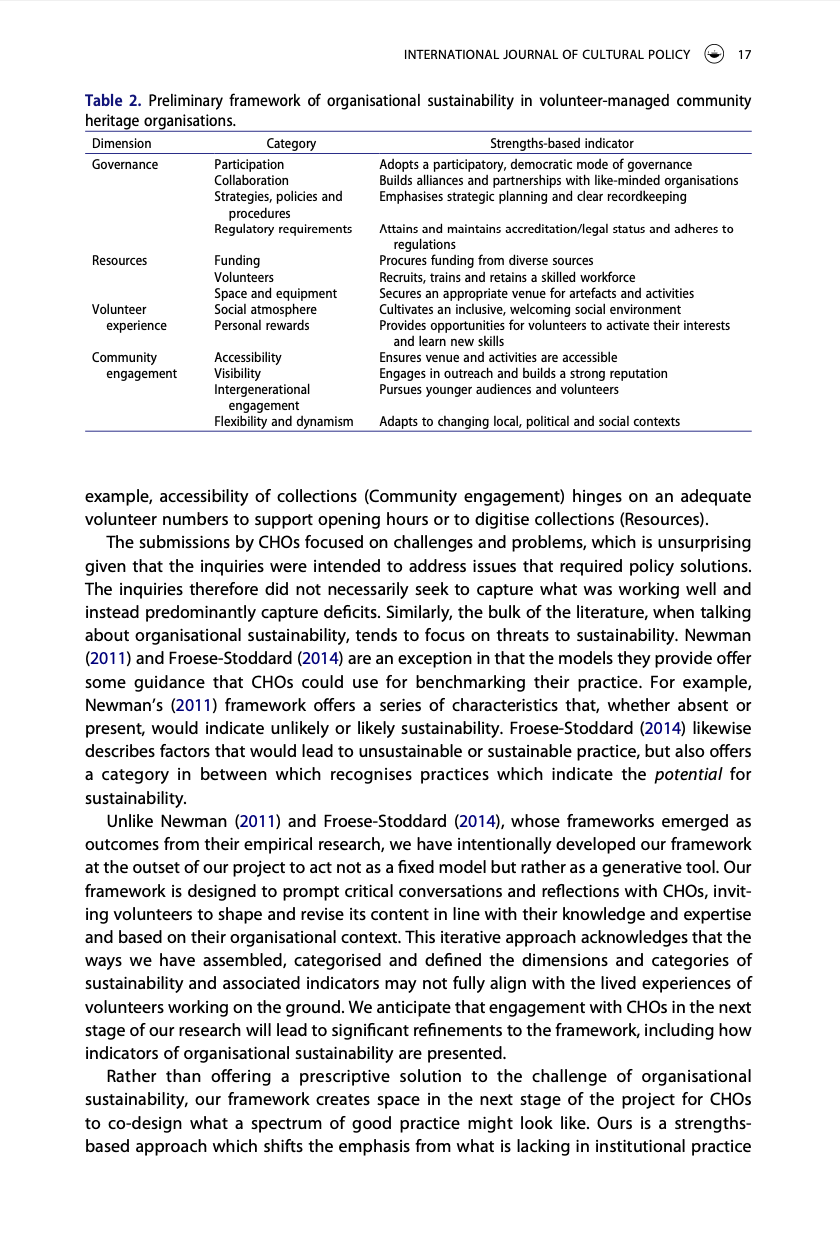
Organisational sustainability in Australia’s volunteer-managed community heritage organisations: A preliminary strengths-based framework with baseline indicators
Zelmarie Cantillon & Sarah Baker
This article reviews scholarly and grey literature to identify aspects of organisational sustainability relevant to community heritage organisations (CHOs), organised into four key dimensions: governance, resources, volunteer experience and community engagement.
To contextualise these dimensions, we draw on written submissions pertaining to sustainability challenges by CHOs to Australian federal, state and territory parliamentary inquiries.
The article presents a preliminary framework with baseline indicators for organisational sustainability in the community heritage sector that takes a strengths-based approach. We argue that the preliminary framework can be used as a basis to develop a co-designed, strengths-based framework that has utility as both a practical tool for CHOs and a policy intervention that highlights the need for greater recognition and support for the community heritage sector within Australia’s national cultural policy.
Reference: Cantillon, Z & Baker, S 2025, ‘Organisational sustainability in Australia’s volunteer-managed community heritage organisations: A preliminary strengths-based framework with baseline indicators’, International Journal of Cultural Policy, https://doi.org/10.1080/10286632.2025.2564746